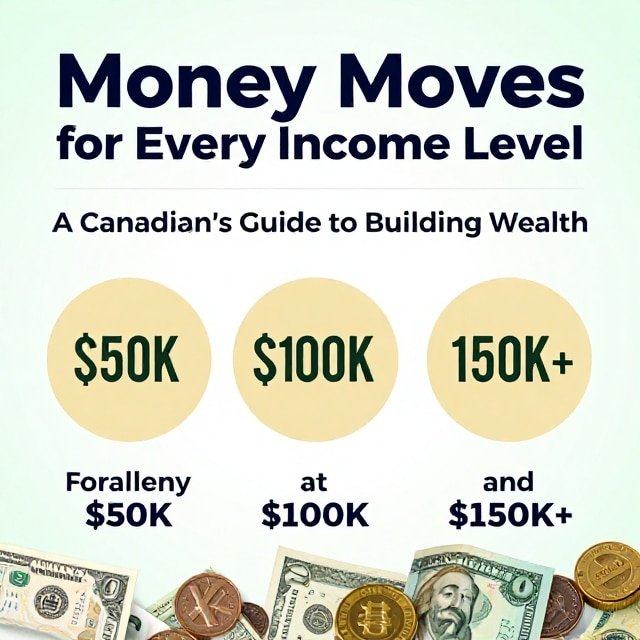

Income alone doesn’t determine financial success — strategy does. Someone earning $50,000 with a disciplined plan can end up in a stronger financial position than someone earning $150,000 without one. Here’s what a thoughtful, income-appropriate financial strategy looks like at three common income levels for Canadians.
Note: This is general financial education, not personalized financial advice. Individual circumstances vary, and a financial professional can help tailor a plan to your specific situation.
Earning $50,000 a Year: Building the Foundation
A $50,000 salary is actually above the Canadian median income, which sits around $45,000. After tax, that translates to roughly $38,000–$40,000 annually, or about $3,200–$3,400 per month, depending on province — money that needs to stretch across rent, groceries, transit, and rising day-to-day costs.
Canadians currently save an average of just 5.7% of their income. Saving even 10% at this income level — around $4,000 a year on a $40,000 after-tax income — puts you ahead of most people and creates the foundation everything else is built on.
Three Priorities at This Stage
1. Build your financial foundation.
- Start with a simple budget — a basic spreadsheet or budgeting app works fine
- Build an emergency fund covering at least three months of expenses
- Pay off high-interest debt first — with average Canadian credit card debt near $5,000 at rates around 20%, eliminating it can save roughly $1,000+ a year in interest alone
- Claim every tax credit you’re eligible for, such as the Canada Workers Benefit or tuition carry-forwards for recent graduates
- Get financially educated — many Canadians don’t fully understand tools like the RRSP, and learning the basics pays off significantly over time
- Open a TFSA, even with small, consistent contributions — the goal at this stage is building the habit of paying yourself first
2. Start long-term investing, even in small amounts. At this income level, a TFSA is often prioritized over an RRSP, since you’re likely in a lower tax bracket (unless your employer offers RRSP matching). Consider a First Home Savings Account (FHSA) if buying a home is a goal, and look at low-fee ETFs or robo-advisors to start investing simply. Consistency matters far more than optimization here.
3. Focus on growing your income, not just cutting expenses. Budgeting has limits — income growth doesn’t. Consider:
- Upskilling through training or certifications with strong career return on investment
- Negotiating a raise, which can boost take-home pay by 5–10% through a single conversation
- Renegotiating recurring bills — phone plans, insurance, rent, subscriptions
- Starting a side hustle once established in your main career
- Being open to switching jobs or companies to accelerate income growth — job-hopping strategically in the early career years can meaningfully compound income over a short period
The habits built at this income level — budgeting, saving consistently, and staying curious about learning and career growth — form the base that later financial success is built on.
Earning $100,000 a Year: From Surviving to Building Wealth
At $100,000, after-tax income typically lands around $68,000–$75,000 annually, or roughly $6,000 a month — a livable amount even in expensive cities, but one that requires intentional planning to actually build wealth rather than simply spend more as income rises.
This is also the point where tracking net worth becomes essential rather than optional. Watching net worth grow over time — similar to leveling up in a game — can be a strong source of motivation and a useful gauge of financial progress relative to others your age.
Key Strategies at This Level
1. Maximize free money and tax efficiency.
- RRSP contributions become more valuable in a higher tax bracket — a $10,000 contribution can save over $3,000 in taxes
- Take full advantage of employer RRSP matching if available — it’s effectively free money
- If married with an income gap between spouses, look into spousal RRSPs
2. Track, optimize, and refine your plan.
- Monitor monthly spending and update net worth regularly (monthly or at minimum quarterly)
- Aim for a savings rate of at least 15% across all accounts
- Maxing out RRSP contributions (18% of income, up to the annual limit) is a strong benchmark at this stage
3. Invest with intention.
- Low-fee ETFs and stocks remain simple, diversified, and effective tools
- Understand your risk tolerance and target asset allocation
- Avoid high-fee mutual funds (anything approaching or exceeding 2% in fees)
- Automate contributions and rebalance annually — consistency outperforms attempts at perfect timing
4. Build a detailed, stress-tested long-term plan.
Consider a hypothetical example: a 35-year-old earning $100,000 annually, spending $60,000 a year, with $70,000 in an RRSP and $50,000 in a TFSA, targeting retirement at 60. Assuming 2% annual growth in income and expenses and a 5% average investment return, consistent saving could grow net worth to around $1.6 million by age 60 — but maintaining that same $60,000 inflation-adjusted spending level in retirement could exhaust those savings by age 84.
A modest adjustment — reducing spending from $60,000 to $56,000 annually and redirecting the difference into a TFSA — can shift the outcome significantly, potentially extending the plan to last until age 100 instead. This illustrates why small, deliberate changes made early can have an outsized impact on long-term financial security.
It’s also worth stress-testing a plan against major life changes: a promotion, an inheritance, marriage, children, starting a business, or delaying government benefits like CPP and OAS. Because these events can meaningfully shift a financial plan, revisiting and updating it regularly — not just setting it once — is essential.
Earning $150,000+ a Year: Making Complex Money Work Harder
At this income level, financial situations often become considerably more complex — incorporated consultants, physicians, executives, business owners, real estate investors, and increasingly, globally mobile entrepreneurs and remote workers earning well into six figures or more.
By this stage, most people have the personal finance basics down and are focused on making their money work harder — and taxes become a central concern, particularly with Canada’s top marginal tax rates exceeding 50%. A common question at this level: “I make good money, but where does it all go?” Often, the answer lies in a combination of taxes and lifestyle creep — a bigger home, nicer vacations, more frequent dining out — that quietly absorbs income growth.
At this level, more advanced financial tools become relevant: corporate structures, holding companies, family trusts, individual pension plans, insurance strategies, and international tax planning. These tools are only effective when applied with a clear purpose — whether that’s early retirement, generational wealth, or long-term flexibility.
Key Focus Areas at This Level
1. Corporate and income structure. Many high earners at this level operate through some form of corporate structure. Key decisions include:
- Using a corporation to defer taxes, manage risk, and invest more efficiently
- Considering a holding company to separate business assets from personal investments
- Balancing salary versus dividends based on personal financial goals
- Corporate retirement planning, including pensions and investment strategies
- Corporate-owned life insurance for tax-sheltered growth and estate planning
- Exit planning for eventual business sale or succession, potentially involving family trusts or estate freezes
2. Legacy and estate planning. Once income and corporate structure are in order, attention often shifts to bigger-picture planning:
- Wills, powers of attorney, and beneficiary designations — especially where businesses or trusts are involved
- Personal and corporate life insurance to protect family and support estate goals
- Wealth transfer strategies for the next generation, whether through gifts, trusts, or inheritance
- Planning for major life transitions, such as selling a business or retiring early
- Charitable giving, whether through direct donations, donor-advised funds, or a foundation
- Coordinating legal, tax, investment, and insurance strategies so they work together cohesively
3. Cross-border and international planning. As global mobility increases, some high earners consider relocating, retiring abroad, or running location-independent businesses. This introduces additional complexity:
- Residency and departure planning — properly and strategically severing Canadian tax residency to avoid unnecessary exit taxes
- Tax treaty optimization — using treaties between Canada and a new country of residence to reduce or eliminate double taxation on RRSPs, pensions, and other Canadian investments
- International investment structures — compliant offshore platforms in jurisdictions like Singapore or Dubai, which can offer tax deferral and currency diversification
- Foreign corporations — structuring international entities to hold global assets or operate a business, potentially reducing overall tax burden while adding legal protection
The Bottom Line
Regardless of income level, the underlying principle is the same: build strong financial habits early, and let your strategy evolve in complexity as your income and life circumstances grow. The habits formed at $50,000 — budgeting, saving consistently, paying down high-interest debt — become the foundation for the wealth-building strategies used at $100,000, which in turn set the stage for the more advanced tax and structuring strategies relevant at $150,000 and beyond. The goal at every stage is the same: build a financial system that scales with your life, rather than one you have to rebuild from scratch each time your circumstances change.